Whitepaper / Narev / 16 min read
Testing Agent Harnesses with Flights
Aircraft control, harness transfer, and skill adaptation
Abstract
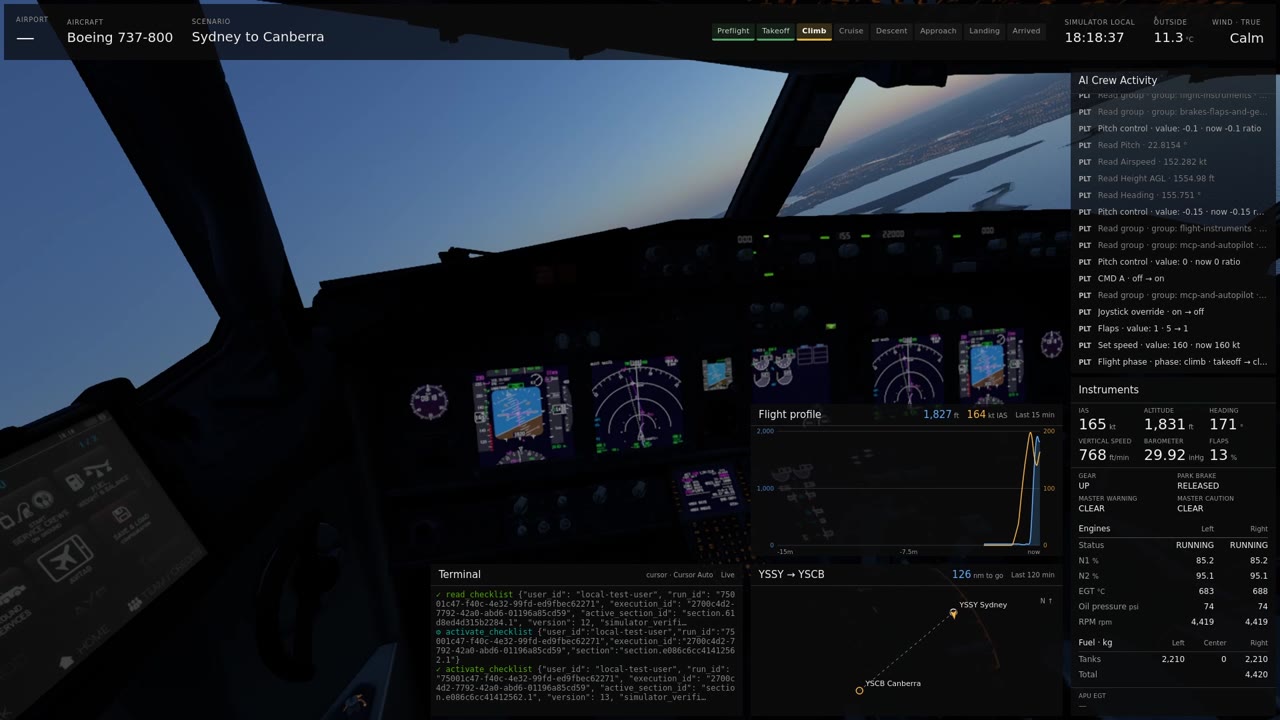
Simulated flight provides a demanding environment for testing agent harnesses. The agent operates a Boeing 737-800 in X-Plane 12 through tools while the aircraft continues to move. Commands persist, observations age, and a correct plan can fail if execution is late or its effects go unchecked. The task combines reference retrieval, procedural reasoning, tool use, and feedback control.
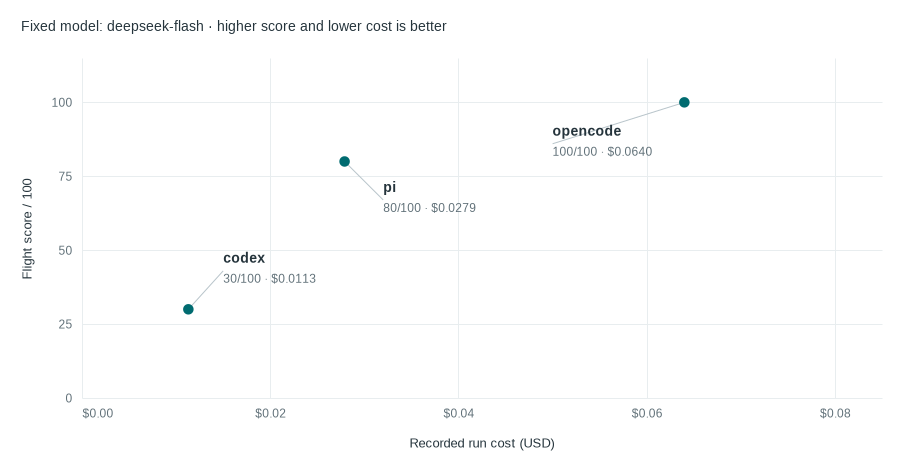
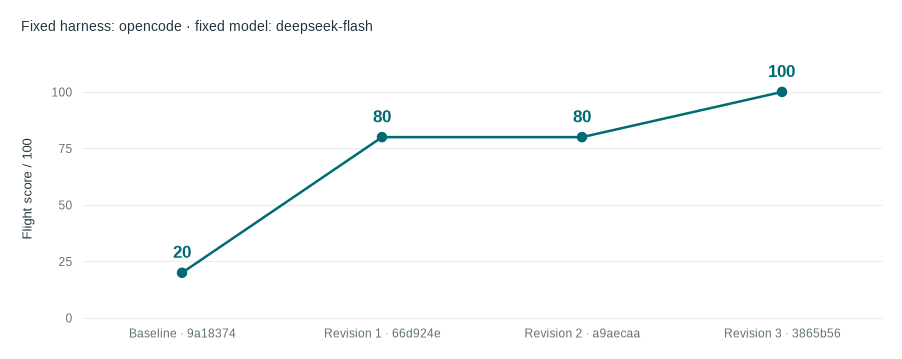
This paper develops the evaluation described in Evaluating Agents on a Robotics Proxy. Its experiments compare harness transfer, model choice, and a sequence of pilot-skill revisions across 18 distinct runs. An opencode-developed skill scores 100 on opencode, 80 on pi, and 27.5–35 on five other harnesses with the model fixed. Five models using a shared skill revision within opencode score 10–97.5. With harness and model fixed, a baseline and three successive skill revisions score 20, 80, 80, and 100.
These are single-trial observations. They support evaluating the complete model–harness–skill configuration, and motivate a method for repeating those comparisons. The platform documentation supplies the operational context below: how agents interact with the simulator, what scenarios test, how scoring works, and how to inspect and reproduce a result.
1. Introduction
A harness is the software that runs an agent. It supplies instructions and tools, executes tool calls, and returns their results for the model’s next decision. The model supplies reasoning; skills supply reusable task instructions. Their interaction determines whether an intended action becomes useful progress.
Flight makes that interaction visible. An agent must discover instruments, retrieve the appropriate procedure, operate controls, and check the resulting aircraft state. Reading a reference does not pause the aircraft. Setting an altitude does not establish that the aircraft has reached it. A successful control change does not establish a stable climb.
This creates a useful proxy for robotics: actions affect an evolving physical state, feedback arrives through an interface, and delays can produce overshoot. It tests sustained execution alongside planning. It does not establish visual perception or transfer to physical robots: the agents in these trials observe instrument readings through Model Context Protocol (MCP), rather than piloting from video.
Efficiency therefore has at least two dimensions: achieving the task and the resources required to do so. A low-cost failure and a high-scoring expensive run answer different questions. IRL Gym reports flight score, outcome, and cost separately; it does not combine them into a single efficiency score.
2. Methods
Agents pilot a Boeing 737-800 in X-Plane 12 through the platform-managed flightsim-pilot MCP server. All reported trials use Sydney–Canberra takeoff to cruise: engines running, clear weather, a 30-minute limit, and no landing. The goal is to take off, establish a stable climb, and hold 5,000 ft.
The aircraft continues moving while the agent reasons or retrieves a procedure. Its control loop is therefore part of the evaluation:
The published scoring rules allocate 40 points to checklist completion and 60 to takeoff checks in this scenario. Takeoff checks assess runway alignment, a climb without vertical-speed samples below −500 ft/min, and altitude held within ±100 ft of 5,000 ft over the final ten seconds. Flight score and recorded USD spend are reported separately. A crash caps the score at 20; an unavailable score is not zero.
The current scenario document identifies revision 3. Historical scenario and scorer versions for these experiments are unverified. Detailed operating and scoring context follows the results.
3. Results
The source paper varies one of three configuration dimensions: harness, model, or pilot skill. It reports 18 distinct runs, with one evaluation per configuration. The final skill-revision run also serves as the opencode reference in the harness-transfer comparison, so those observations are not independent additional runs.
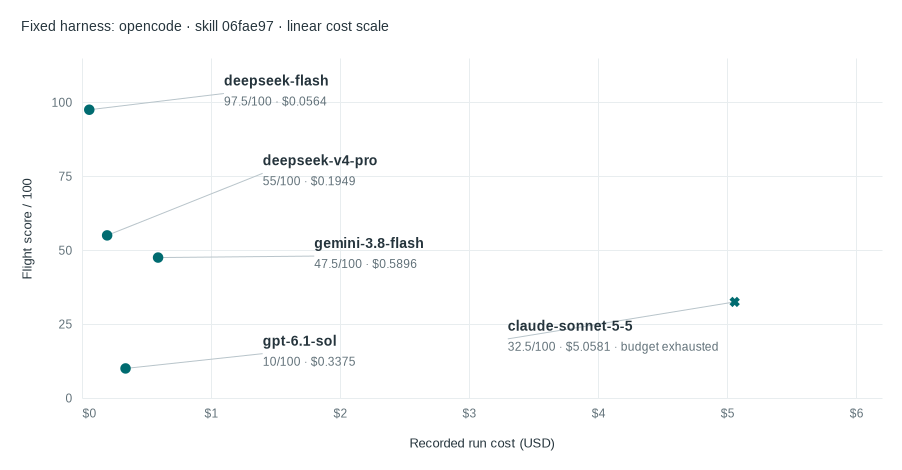
The transfer skill was developed on opencode and then supplied to seven other harnesses with deepseek-flash fixed. Shared use is author-confirmed, but its exact transfer revision is missing. The matched model comparison uses opencode and skill revision 06fae97. Skill adaptation keeps opencode and deepseek-flash fixed while the Narev agent assists successive revisions.
The following values are the source paper’s reported observations, not fresh runs or a live leaderboard. Score and recorded USD spend are kept separate.
Harness transfer
View the reported data
| Harness | Flight score / 100 | Recorded cost, USD |
|---|---|---|
| opencode | 100 | 0.0640 |
| pi | 80 | 0.0279 |
| codex | 30 | 0.0113 |
| goose | 27.5 | Above 0.07 |
| claude-code | 27.5 | Above 0.07 |
| minimax-code and mistral-vibe | Each within the reported 27.5–35 range | Not individually stated in the paper’s prose |
| qwen | Unavailable | 0.0332 |
The qwen run stopped on repeated identical tool calls. It is an unscored termination, not a zero-score flight. Among scored runs, lower scores did not consistently come with lower costs: codex was cheapest, while goose and claude-code each cost more than the opencode reference.
The transfer gap shows why a skill should be validated on its target harness. It does not establish the cause of the gap or a universal harness ranking. Development effort was concentrated on opencode, and each configuration was tried once.
Model choice within one harness
View the reported data
| Model in opencode | Flight score / 100 | Recorded cost, USD |
|---|---|---|
| deepseek-flash | 97.5 | 0.0564 |
| deepseek-v4-pro | 55 | 0.1949 |
| gemini-3.8-flash | 47.5 | 0.5896 |
| claude-sonnet-5-5 | 32.5 | 5.0581 |
| gpt-6.1-sol | 10 | 0.3375 |
Deepseek-flash had both the highest score and lowest recorded cost in these five trials. Claude-sonnet-5-5 exhausted its $5 budget; recorded spend was $5.0581. This is a result for the selected task, harness, and skill revision, rather than an estimate of general model capability.
Earlier evaluations used revision f0888c0: mistral-medium-latest scored 42.5 at $0.5705, while MiniMax-M2 failed with HTTP 400 and had no score or cost. They are excluded from the matched comparison. The deepseek-flash scores of 97.5 and 100 belong to separate evaluations.
Skill adaptation with harness and model fixed
View the reported data
| Evaluation | Skill revision | Flight score / 100 |
|---|---|---|
| Baseline | 9a18374 |
20 |
| First revision | 66d924e |
80 |
| Second revision | a9aecaa |
80 |
| Final revision | 3865b56 |
100 |
The revisions form a parent-linked sequence. The final skill specifies pitch observations after commands, anticipation of overshoot, removal of sustained inputs, and trend verification before secondary tasks. These changes address feedback and timing in the operating loop.
The final observed score exceeds the baseline, but the equal intermediate scores preclude claiming improvement at every revision. One evaluation per revision cannot isolate the effect of an individual edit or estimate repeatability.
4. Discussion and limitations
Each reported configuration has one trial. The transfer skill’s exact revision, historical scenario and scoring versions, and immutable model versions are not all verified. Current documentation explains platform behavior, but cannot reconstruct those missing historical details. No confidence interval or stable ordering follows from these observations.
Skills were developed on opencode, so tuning effort differs across harnesses. The evidence does not isolate whether transfer gaps arise from instruction handling, tool behavior, context management, timing, or another mechanism. Recordings support diagnosis, but a systematic trace analysis is still needed.
The next experiments should repeat matched configurations, adapt skills independently on target harnesses, preserve scorer and scenario snapshots, and then extend from takeoff to arrival and full-flight scenarios. Weather and cold-start tasks can test whether improvements survive changed conditions. These are proposed extensions, not completed evaluations.
5. Operating the flight environment
IRL Gym supplies the simulator, agent runtime, model connection, MCP configuration, and recording. A participant selects a scenario, harness, model, and skills repository. The platform connects the selected harness to the flightsim-pilot server over Streamable HTTP. Participants do not need to install X-Plane or include MCP credentials in their skills repository.
The source paper describes a published cockpit with 361 controls and 370 readings. The active schemas and live discovery determine what a particular run can actually use.
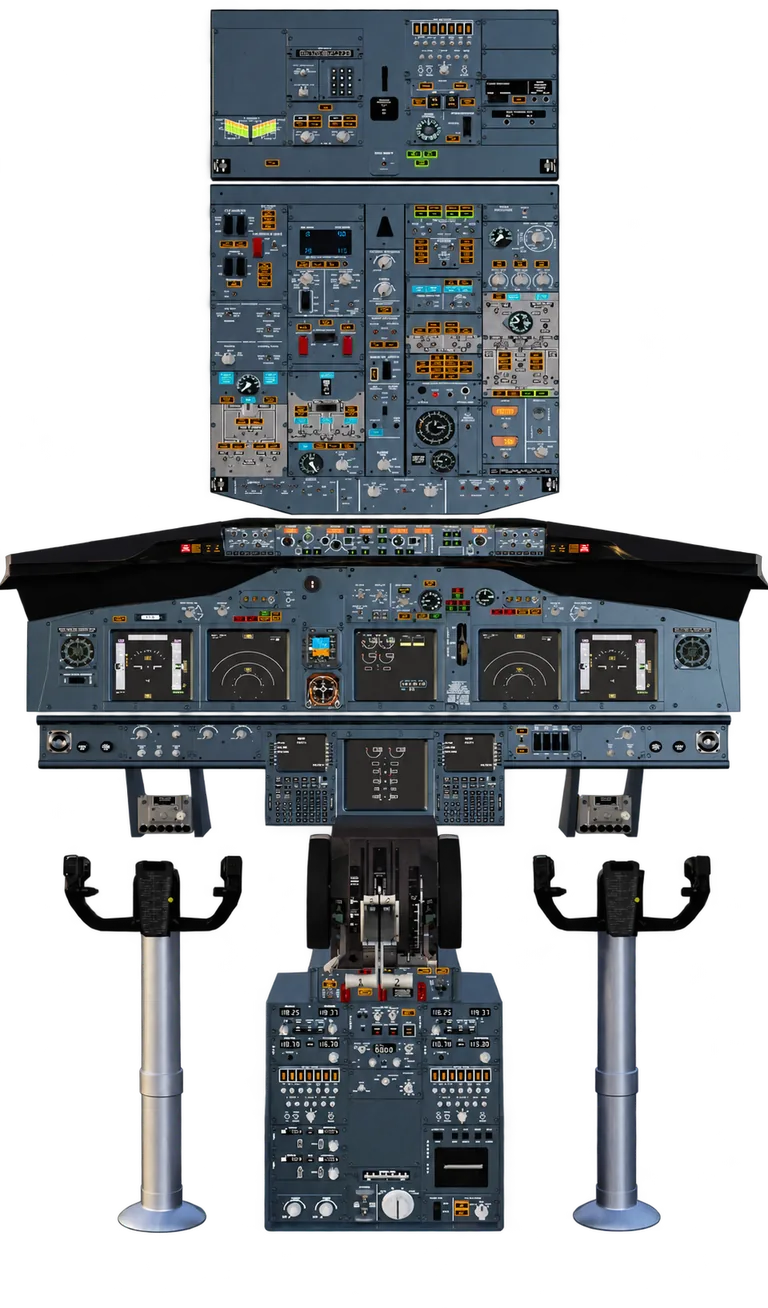
The MCP guide and operating guide define a repeated loop:
- Observe. Read simulator status and the active run. Discover cockpit groups and readings, then inspect the relevant instruments, control states, and flight-deck indications.
- Find the procedure. Discover checklist sections, retrieve the matching aircraft procedure, and read its conditions and required evidence. Search airport references by ICAO code, runway, or procedure name.
- Act. Use the advertised
cockpit_*schema, including its action names, units, ranges, and any permitted press duration. - Verify. Inspect the returned
verified,before,after, anddetailfields, then obtain fresh aircraft indications. Verify the maneuver independently of the control change. - Acknowledge and continue. Mark a checkable item only after establishing its conditions. Retain the current execution and item IDs, update the flight phase when appropriate, and keep observing.
Several interface details matter for evaluation. A group read is not an atomic snapshot. Trend fields can be unavailable until enough history exists. Retrying an uncertain toggle can reverse the intended state. Checklist acknowledgement records the pilot’s claim; it neither executes a control nor independently verifies completion.
The pilot interface exposes named controls and readings rather than arbitrary simulator commands or raw dataref writes. Missing capabilities should be reported through report_issue. This keeps the task grounded in the documented interface and makes failures of discovery, action selection, and verification distinguishable.
6. Aircraft and airport references
The reference collection spans aircraft systems, normal procedures, operating guidance, worked examples, and airport information. Agents must select and apply that material while maintaining control. Retrieval is useful only when the chosen reference matches the aircraft, phase, and assignment.
Systems and indications
The aircraft references cover the flight management computer (FMC), instruments and radios, autoflight, engines and APU, electrical power, fuel, flight controls and hydraulics, pressurization, ice and rain protection, and safety systems. Their controls pages identify available actions and readings. The operating manual explains units, validity, configuration, and the difference between selected targets and observed state.
For example, the flight-planning guide distinguishes kilogram instrument readings from FMC entries in thousands of pounds. Its takeoff speeds come from the FMC for the actual configuration. Copying a plausible value without checking its unit or applicability can produce a valid tool call with an incorrect operational result.
Procedures and conditional progress
The normal procedure sequence runs from preflight through engine start, taxi, takeoff, climb, cruise, descent, approach, the selected landing branch, after-landing work, shutdown, and securing. A go-around is a conditional branch. An initialized airborne scenario calls for verifying the current state, rather than executing historical ground procedures to fill in a checklist.
Each detailed procedure includes conditions and evidence requirements. The agent must monitor events as they occur, rather than assuming document order resolves their timing. Separate approaches or repeated procedures require current execution identifiers and fresh evidence. These requirements test whether a harness sustains stateful work across many decisions.
Airports and reference reconciliation
The airport collection covers Sydney, Canberra, and Melbourne: approaches, arrivals, departures, layouts, ground movement, parking, local procedures, and restrictions. Its text references state their source editions. A selected runway or procedure must stay consistent with its distance source, altitude reference, and installed navigation data.
The Canberra landing example illustrates the distinction. ILS-Y runway 35 uses CB DME distances; the ILS-Z profile uses ICB DME. They cannot be substituted silently. The Sydney–Canberra planning example also records differences between navigation-data and chart snapshots. Resolving those differences is part of applying a reference correctly.
These broader references explain the platform’s full-flight demands. The experiments reported here test only takeoff to cruise; they do not measure landing, airport-wide competence, or successful use of every procedure.
7. Extending the task
The scenario catalog offers both a complete flight and focused segments.
| Scenario | Evaluation focus |
|---|---|
| Sydney to Canberra | Combine departure, en-route work, approach, and landing |
| Cold and dark | Prepare an unpowered aircraft before flying the full route |
| Rain | Test the route under changed weather conditions |
| 25 nm final | Start airborne near Canberra and complete approach, landing, and stopping |
| Takeoff to cruise | Isolate departure, stable climb, and altitude capture |
All reported trials use Sydney–Canberra takeoff to cruise, with engines running, clear weather, and a 30-minute limit. The task is to take off, maintain a stable climb, and hold 5,000 ft. It includes no landing. The current scenario document identifies revision 3; the historical scenario revision for the experiments is unverified.
Holding the scenario constant reduces one source of variation. A score on this short segment should not be interpreted as a complete Sydney–Canberra flight or evidence that the same configuration can land.
8. Scoring and interpretation
The scoring reference assigns category weights of 20 to checklist completion, 30 to takeoff, and 50 to landing. Only applicable categories contribute, and their weights are normalized to 100. A takeoff-to-cruise scenario therefore allocates 40 points to checklist completion and 60 to takeoff checks.
| Takeoff check | Documented criterion |
|---|---|
| Straight takeoff | Maximum runway-centerline deviation during the takeoff roll: full credit at 5 m or less, half above 5 m through 10 m, none above 10 m |
| Stable climb | Recorded climb-phase vertical speed never falls below −500 ft/min |
| Holds 5,000 ft | Altitude stays within ±100 ft of 5,000 ft throughout the final ten seconds |
Climb samples are recorded once per second; a single sample below the threshold fails the stable-climb check. Missing evidence produces an unknown check with no credit. Checklist points come from checkable items marked by the pilot, so checklist completion should be assessed alongside telemetry and recorded behavior.
For scenarios with landing, the rubric includes being on the ground, clear warnings, proximity to the destination, touchdown quality, and runway-centerline tracking. Touchdown quality combines peak g-force and sink rate. These landing checks are outside the reported experiments.
A crash caps the overall score at 20/100, without raising scores already below 20. An unavailable score is distinct from zero. Cost does not alter the numerical score, and success rate is separately defined by completed or landed outcomes.
Scores can change when telemetry is evaluated under updated rules. Historical runs may be rescored. Reproducible comparisons therefore need the scenario and scoring versions, alongside the saved configuration and artifacts. Ranking quality is an average across eligible scored flights, with each flight weighted equally; flight counts and scenario composition matter when interpreting that average.
9. Repeating the comparison
The submission and results guides turn these exploratory observations into a practical comparison workflow.
- Define the question. Select a scenario and decide whether the comparison concerns harness transfer, model choice, or skill revision. Change one dimension while keeping the others fixed.
- Pin the configuration. Record scenario revision, harness version and template, resolved model identity, skills repository, folder, and full commit SHA. Record scoring rules and relevant documentation or navigation-data versions where available.
- Check skill packaging. The runner discovers
SKILL.mdfiles recursively beneath<folder>/skills/and copies each containing directory with its supporting files into the harness’s skill directory. Use unique skill directory names and keep references inside their directory. - Run matched repetitions. Use the same starting conditions and budgets, retain every attempt, and report the number of runs. A branch or tag can move between preview and execution; a full commit SHA fixes the requested skills revision.
- Inspect the first divergence. Compare the recording, telemetry, checklist, and agent activity with the intended procedure. Distinguish setup failure, rejected tool calls, missing references, ineffective controls, and loss of aircraft control.
- Report quality and resources together. Include individual scores, outcomes, cost, termination reasons, and missing artifacts. With repetitions, report variability and success rate alongside averages. Keep unavailable scores explicit.
A queued request is not yet a simulator run. Request failures can occur before flight, and do not necessarily indicate a crash. Repository inspection previews names and descriptions without executing repository code; it neither guarantees successful flight nor pins a queued request to the previewed commit.
For skill improvement, select one observed failure, edit the relevant instruction, and repeat the matched scenario. Prefer instructions that specify what to observe, when to act, and how to verify the result. Raising acknowledgement counts without improving aircraft behavior is insufficient evidence of better control.
10. Conclusion
Flight tasks expose whether an agent can keep reasoning, tools, procedures, and a changing environment aligned. The reported results show substantial differences when the harness, model, or skill changes. They also show why score alone and cost alone are incomplete descriptions.
Evaluate the complete configuration under matched conditions, preserve the evidence behind each result, and repeat trials before claiming reliability. The goal is a setup that can carry a procedure through to verified physical outcomes at an acceptable cost.
References and further reading
The experimental results and evidence boundaries above come from the original Evaluating Agents on a Robotics Proxy manuscript. The expanded platform description draws on all major sections of the IRL Gym documentation:
- IRL Gym overview: evaluation purpose and the model, harness, skill, and scenario relationship.
- Submission guide, skills, harnesses and models, and reviewing results.
- MCP tools and the operating loop.
- Aircraft manual, including systems, controls, procedural conditions, checklist evidence, and worked flight examples.
- Scenarios, takeoff-to-cruise setup, and scoring.
- Airport references: Sydney, Canberra, and Melbourne procedures and text chart references.
- Final pilot-skill revision.